
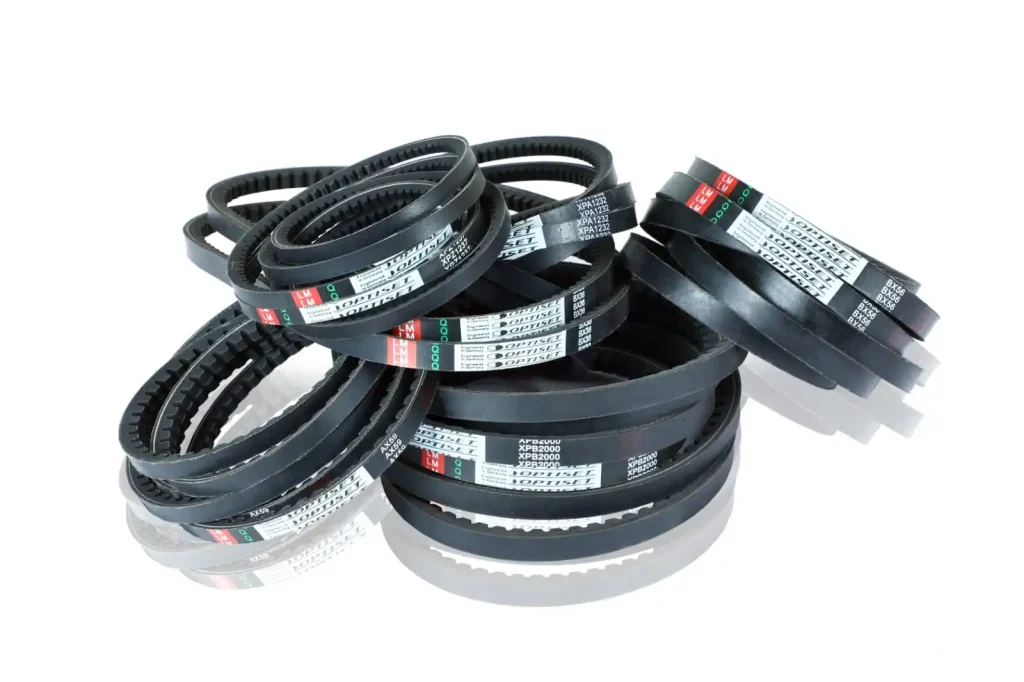
A cogged belt is a V-belt with notches, or cogs, on its inner side. It runs in V-groove pulleys, grips by friction and bends easily around smaller pulleys, so it runs cooler and lasts longer than a standard wrapped V-belt. A timing belt is a toothed belt that meshes with toothed pulleys, so it never slips and keeps two shafts perfectly in sync.
Choose a cogged V-belt when you need strong, reliable power transmission and can accept a small amount of slip, as in pumps, fans, compressors and general machinery. Choose a timing belt when the shafts must stay synchronized, as in engines, packaging machines, CNC machines and automation equipment.
Are Cogged Belts and Timing Belts the Same?
No. Both have “teeth” or “cogs”, so the names are often mixed up (people even search for “cogged timing belt”), but they transmit power in different ways.
- Cogged V-belt: The notches are on the underside to make the belt more flexible and help it run cooler. The belt still wedges into a smooth V-groove pulley and transmits power by friction.
- Timing belt: The teeth are the working surface. They mesh with matching grooves on a toothed pulley, which makes it a positive drive with no slip.
What is a timing belt?
A timing belt, also called a synchronous belt, is a toothed belt that meshes with toothed pulleys to transmit power with no slip. Because the teeth lock into the pulley grooves, the driving and driven shafts always stay in exact sync. Timing belts are made of rubber or polyurethane (PU) with tensile cords, and they are used in car engines as well as in industrial machines. In an engine, the timing belt works like the conductor of an orchestra: it keeps the crankshaft and camshaft moving together.
What are timing belts used for?
Your pu timing belt ensures the engine’s combustion cycle runs smoothly by linking the crankshaft and the camshaft.
The crankshaft moves with the pistons, while the camshaft controls intake and exhaust valve movement.
In each cylinder, intake valves open to let air and fuel in. After the right mix enters, the camshaft shuts the valves, and the piston compresses the mix.
The spark plug ignites it, pushing the piston back down, rotating the crankshaft.
Then, the camshaft opens the exhaust valve, letting out exhaust gases. This cycle repeats.
For this to work without damaging the engine, valves and pistons must move precisely, coordinated by the timing belt’s transmission of crankshaft rotation to the camshaft.
Timing Belts in Industrial Machinery
Beyond engines, timing belts are used wherever motion must be precise and repeatable:
- Packaging and printing machines
- CNC machines and 3D printers
- Textile machinery
- Conveyors and material handling
- Robotics and factory automation
- Medical and laboratory equipment
Industrial timing belts are available in rubber and PU (polyurethane), and in profiles such as T5, T10, AT10 and HTD. Rubber timing belts suit general-purpose drives, while PU timing belts are often chosen where abrasion resistance, clean running or precise positioning matters. Explore our rubber timing belts and PU timing belts.
Benefits of a Timing Belt
Even though you don’t see them, pu timing belt manufacturers make timing belts that are significant in keeping your engine running well and machines working efficiently. Here’s what makes them so beneficial. Here’s a breakdown of some key advantages:
- Precise Timing: The timing belt keeps the engine running smoot. This is to ensure perfect timing between the crankshaft and the camshaft. This allows valves to open and close at the right moments for optimal engine performance. Without this precise timing, engine performance suffers, and potential damage can occur.
- Reduced Noise: Timing belts India run smoother and quieter than timing chains, making your car and other machines less noisy. This means a more peaceful driving experience for you!
- Low Maintenance: Timing belts generally require less maintenance compared to timing chains. They don’t need lubrication, which simplifies upkeep and reduces associated costs.
- Efficient Power Transmission: Pu timing belt grips pulleys well but slides smoothly, so less power is lost. This means better engine performance. This translates to better fuel economy and improved engine performance.
- Compact Design: Timing belts India are typically smaller and lighter than timing chains. This allows for a more compact engine design, freeing up space for other components.
- Durability: Today’s timing belts use tough, reinforced materials to last for many miles or hours of operation. They can last for many miles or hours of operation before needing replacement.
- Cost-Effective: They are cheaper to replace than timing chains, and since they require less maintenance, they save money in the long run. Also, their lower maintenance needs further contribute to cost-effectiveness.
What is a cogged belt?
A cogged belt, also called a cogged V-belt, is a V-belt with evenly spaced notches (cogs) cut across the underside. The notches reduce bending resistance, so the belt wraps more easily around smaller pulleys and generates less heat. Cogged V-belts are made as raw-edge belts in classical sections (AX, BX, CX) and narrow sections (XPZ, XPA, XPB, XPC), and they run in the same V-groove pulleys as standard V-belts.
Unlike wrapped V belts, cogged drives produce less heat and have longer lifespans. Moreover, they offer higher friction coefficients.
This ensures superior power transmission compared to wrap-moulded belts.
The notched design of cogged belts works well on smaller pulleys, helping pu timing belt manufacturers use less metal in sheave design.
Adhering to industry standards for the smallest sheave diameter ensures safety and lowers motor shaft load.
Benefits and Uses of Cogged Belts
Cogged belts, with their distinctive teeth, offer a range of advantages for various applications:
- Enhanced Power Transmission: The notched underside lets the belt bend around the pulley with less resistance, so it grips the groove walls well. A cogged belt can transmit more power than a wrapped V-belt of the same section, with less slip.
- Longer Life, Lower Maintenance: Cogged belts run cooler because the notches release heat and reduce bending stress. They wear more slowly and need replacing less often, which saves on maintenance and cost.
- High Speeds and Efficiency: Cogged belts can handle faster speeds than V-belts without shaking too much. This improved efficiency contributes to better overall machine performance.
- Quiet Operation: The precise fit between cogs and grooves reduces noise generation compared to V-belts. This creates a quieter working environment for machines and a more pleasant driving experience in vehicles.
- Compact Design: Similar to timing belt, cogged belt is often more compact than traditional V-belts. This allows for space optimization in machinery design.
- Versatility: Cogged belts work well in many areas. It works well from running big machines in factories to powering farm tools, lawnmowers, and even some parts of cars.
Cogged V-Belt vs Timing Belt
| Aspect | Cogged V-Belt | Timing Belt |
| Design | V-shaped belt with notches (cogs) on the underside | Flat belt with teeth on the inner surface |
| Drive type | Friction drive, wedges into a V-groove | Positive drive, teeth mesh with a toothed pulley |
| Pulleys | Standard V-groove pulleys | Toothed (synchronous) pulleys |
| Slip | Low, but some slip is possible | None |
| Synchronization | No | Yes, shafts stay in exact sync |
| Flexibility | High, suits smaller pulleys | Depends on the profile and minimum pulley size |
| Heat | Runs cooler than a wrapped V-belt | Low heat, no slip |
| Alignment and tension | Tolerates minor misalignment | Needs accurate alignment and correct tension |
| Lubrication | Not needed | Not needed |
| Typical applications | Pumps, fans, compressors, crushers, agricultural and general machinery | Engines, packaging, CNC, printing, textile and automation machines |
| Cost | Generally lower | Generally higher, including toothed pulleys |
How to Choose the Right Belt
How to Choose Between a Cogged Belt and a Timing Belt
Ask these questions:
- Must the shafts stay synchronized? If yes, choose a timing belt. If no, a V-belt or cogged V-belt is enough.
- What pulleys do you already have? V-groove pulleys take V-belts and cogged V-belts. Toothed pulleys are needed for timing belts.
- How much power and shock load is there? Cogged V-belts handle higher loads and shock better in general machinery.
- How small are the pulleys? Cogged belts bend easily around smaller pulleys. Check the minimum pulley size for any timing belt profile.
- How exact is the alignment? Timing belts need tighter alignment and tension than V-belts.
- What is the environment? Heat, oil and dust may call for specific materials (rubber or PU).
Conclusion
Cogged V-belts and timing belts solve different problems. Use a cogged V-belt for strong, efficient power transmission on V-groove pulleys, and use a timing belt where shafts must stay in exact sync. If you are replacing a standard V-belt that wears out too fast, a cogged belt is usually the easiest upgrade.
Jigna Sales Corporation supplies cogged belts, rubber timing belts and PU timing belts for industrial machinery, and serves customers as a timing belt dealer in Mumbai and across India. Contact us with your drive details and we will help you choose the right belt.