
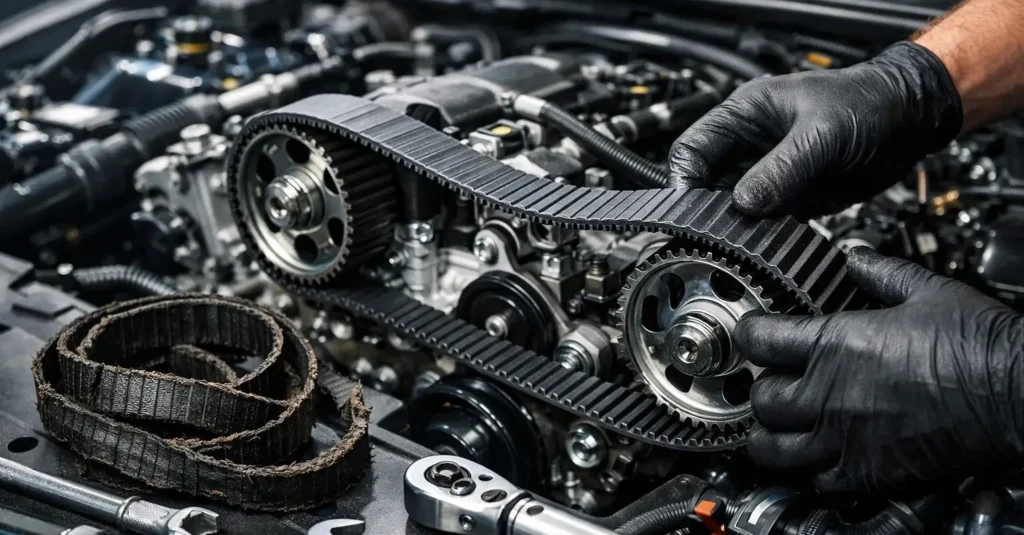
Timing belts are designed to be replaced before they fail. Here’s how mileage, time, and manufacturer guidelines come together in 2026.
A timing belt is a replace-before-failure component. If it breaks unexpectedly, the damage can be severe and expensive. That is why missing the recommended timing belt replacement schedule is one of the most common and costly maintenance mistakes.
There is no universal timing belt replacement rule that applies to every car. Manufacturers set specific mileage and time limits, and replacement is required at whichever comes first.
This 2026 guide explains typical replacement ranges, why the owner’s manual matters most, early timing belt symptoms to watch for, and a practical checklist to help you act before problems begin.
Timing Belt Replacement Interval in 2026: What Most Drivers Should Know
Typical Range Based on Mileage
In many vehicles, timing belt replacement is recommended somewhere between 50,000 and 100,000 miles. This range often appears when drivers search for car timing belt replacement mileage, but it should only be used as a reference point.
Different engines apply different loads and temperatures to the belt. Because of this, one car may safely reach the upper end of the range while another requires earlier replacement. Always confirm the exact interval in your owner’s manual and treat mileage ranges as guidance, not a guarantee.
Typical Range Based on Time
Distance is just as important as time. Even if the car has low mileage, many manufacturers advise to replace the timing belt every 5 to 10 years.
Heat cycles, moisture, and environmental exposure cause rubber parts to wear out over time. A car that is driven infrequently can still develop timing belt problems symptoms simply because the belt has aged.
The Only Correct Timing Belt Replacement Schedule: Your Owner’s Manual
Why Manufacturer Intervals Differ
Timing belt replacement schedules vary because engine designs vary. Belt length, routing complexity, operating temperature, and engine layout all influence belt life.
Some engines place constant stress on the belt, while others operate under lighter loads. This is why two vehicles with similar mileage may require replacement at very different intervals.
The “Whichever Comes First” Rule
Manufacturers specify replacement at a certain mileage or a certain number of years. Replacement is required when either limit is reached first. Ignoring one limit because the other seems low increases the risk of failure.
If You Bought a Used Car
If there is no clear record of when the timing belt was last replaced, assume it is due. Waiting for bad timing belt warning signs is risky because belts can fail without notice.
Factors That Can Shorten How Often to Replace a Timing Belt
Driving Conditions and Environment
Short trips, stop-and-go traffic, high heat, and dusty conditions accelerate belt aging. These real-world factors often reduce belt life compared to ideal conditions.
Oil and Coolant Leaks
Oil or coolant contamination weakens belt material. Many timing belt problems symptoms begin after leaks go unnoticed. Fixing leaks early can prevent premature belt failure.
Interference Engine Risk
In interference engines, a broken timing belt can cause internal engine damage. In these cases, following the recommended replacement schedule is especially critical.
Signs of a Failing Timing Belt You Should Not Ignore
Common Timing Belt Symptoms Drivers Notice
Some drivers experience rough idling, engine misfires, reduced power, or difficulty starting. These timing belt symptoms may appear gradually or suddenly. Unusual ticking or clicking sounds from the engine area can also be early signs of a failing timing belt.
It is important to treat these as warning indicators, not confirmation. Diagnosis should always be done by a qualified mechanic.
Bad Timing Belt Warning Signs Mechanics Look For
During inspection, mechanics may find cracking, fraying, glazing, or missing belt teeth if the belt is visible. These are clear bad timing belt warning signs and usually require immediate replacement.
One important point to remember is that many timing belt problems symptoms appear late or not at all. This is why sticking to the schedule is safer than waiting for visible failure signs.
What to Replace Together: The Smart Timing Belt Service Package
Belt, Tensioner, Idlers, and Water Pump
Most workshops recommend that you should change the timing belt, tensioner, and idler pulleys all at the same time. The belt drives the water pump in many engines, so that should also be taken into account.
Replacing these parts all at once saves time and lowers the chance of a new belt breaking because of an old supporting part.
Checks to Request During Service
Ask for pulley inspection, correct belt routing, proper tension setup, leak checks, and coolant condition review. These steps help ensure long-term reliability.
2026 Quick Decision Guide
- Check your owner’s manual for the exact timing belt replacement interval in miles and years.
- Compare it with your vehicle’s mileage and age and follow whichever comes first.
- If service history is unclear, book an inspection and plan replacement proactively.
- Request a bundled service that includes the belt, tensioner, idlers, and discussion of the water pump.
The Smart Approach to Timing Belt Replacement in 2026
In 2026, the safest answer to how often to replace a timing belt remains simple. Follow the manufacturer’s mileage and time limits and do not exceed them. Waiting for symptoms or warning signs introduces unnecessary risk.
For passenger vehicles, replacement should always follow OEM guidance and be handled by a trusted mechanic. For industrial timing belts and power transmission belts used in machinery, manufacturing lines, and plant operations, the same principles apply but the applications differ. This is where Jigna Sales becomes relevant for engineers and maintenance teams. As an experienced industrial belts manufacturer and supplier in India, Jigna Sales supports precision and durability requirements across industrial environments, helping operations avoid downtime and maintain consistent performance beyond automotive use.
If you manage industrial equipment, choosing the right belt and replacing it at the right time is just as critical as it is in automotive systems.
FAQs
A timing belt failure can cause serious engine damage, especially in an interference engine, where pistons can collide with valves if timing is lost. This may result in bent valves, damaged pistons, or complete engine failure, which is far costlier to repair than replacing the timing belt on schedule.
It’s generally recommended to replace related components at the same time — such as the water pump, tensioner, and idler pulleys — because they often wear out on a similar schedule. This saves labour costs in the long run, as many of these components are accessed during the same service.
Timing belt replacement depends on both mileage and age. Even if your car hasn’t reached the recommended kilometres, the belt material degrades over time due to heat, oil exposure, and rubber aging. That’s why manufacturers specify a time limit (usually 5–7 years) alongside mileage intervals.
Driving with a worn timing belt is high-risk and not recommended. A weakened belt can snap without warning, potentially causing severe engine damage. If inspection shows cracking, glazing, or looseness, immediate replacement is safer and more cost-effective.
Yes. Frequent stop-and-go traffic, aggressive acceleration, extreme temperatures, and short trips can shorten timing belt lifespan. Vehicles driven mainly in city conditions often need earlier replacement compared to those driven on highways.