
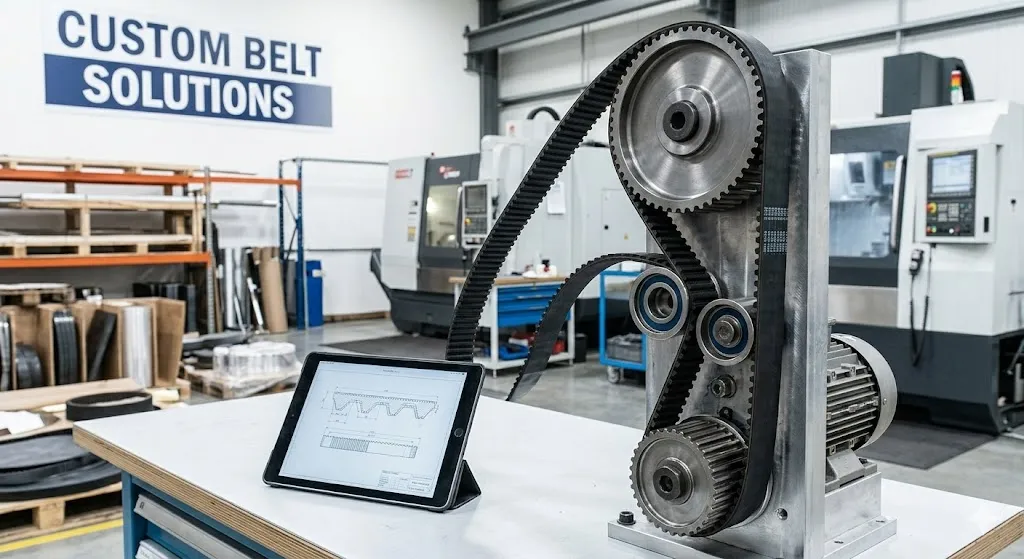
Industrial machines do not all run under the same conditions. Here’s how leading cogged belt manufacturers design customised cogged belt, cogged v belt, and cogged timing belt solutions to meet specific load, speed, and space requirements across industries.
In industrial machinery, small components often make a big difference. One such component is the cogged belt. At first glance, it may look like a simple belt with grooves. But in reality, it plays a key role in improving performance, efficiency, and reliability.
Unlike standard smooth belts, a cogged belt is designed to handle specific industrial challenges. From heavy loads to compact machine layouts, modern cogged belt manufacturers create customised solutions that fit exact operational needs.
Let’s understand how they do it.
What Exactly Is a Cogged Belt and Why Is It Useful?
A cogged belt is a belt with small notches or grooves on its inner surface. These grooves are called cogs. They are not just for design. They improve flexibility and grip.
A cogged V-belt is commonly used in industrial drives where strong traction and better bending ability are needed. The notched design allows the belt to move smoothly over pulleys, especially smaller ones.
A cogged timing belt is used in systems that require accurate power transmission and precise synchronisation. This is important in machinery where timing and alignment directly affect performance.
Here are some key benefits:
- Better grip on pulleys
- Reduced slippage
- Improved flexibility
- Enhanced airflow for cooling
- More efficient power transmission
These features make cogged belts suitable for demanding industrial environments.
How Are Cogged Belt Designs Different From Traditional Belts?
This is a common question.
Traditional belts have a smooth inner surface. A cogged belt has a notched design. That difference changes how the belt behaves.
Here is a simple comparison:
| Feature | Traditional Belt | Cogged Belt |
| Inner Surface | Smooth | Notched |
| Flexibility | Moderate | High |
| Grip | Standard | Improved |
| Heat Dissipation | Limited | Better |
| Performance in Small Pulleys | Moderate | Excellent |
The cogs reduce bending resistance. This allows the belt to wrap around smaller sheaves without losing efficiency. Because of this, machines can be designed more compactly.
For industries where space and performance both matter, this design becomes very valuable.
What Industrial Challenges Do Cogged Belt Manufacturers Solve?
Every industry faces different operational challenges. That is why experienced cogged belt manufacturers focus on solving real performance issues.
Handling Heavy Loads with Reduced Slippage
Heavy-duty machines need strong traction. A cogged V-belt improves pulley engagement. The notches help maintain consistent contact, even under load.
This reduces slipping and ensures a stable transfer of motion.
Supporting Compact and Space-Constrained Setups
Many modern machines are built to save space. Smaller pulleys are often used in such designs.
Because a cogged belt bends more easily, it performs well in compact setups. This allows engineers to maintain efficiency without increasing machine size.
Addressing Thermal and Wear-Related Stress
Continuous operation generates heat. Excess heat reduces belt life.
The grooves in a cogged belt improve airflow. Better cooling means less wear and longer service life.
For industries that run machines for long hours, this is a major advantage.
What Custom Options Do Cogged Belt Manufacturers Offer?
Industrial requirements are rarely identical. That is why customisation is important.
Reliable cogged belt manufacturers provide options such as:
- Custom belt widths
- Specific lengths
- Modified tooth shapes and pitch
- Special reinforcement layers
- Material selection based on application
For example:
- Conveyor systems may need strong, durable cogged V-belts for consistent load movement.
- Compressors and HVAC systems may require belts that handle continuous stress.
- Agricultural machinery may need belts that withstand dust and variable loads.
- Precision machines may rely on a carefully designed cogged timing belt for accurate motion control.
Customisation ensures the belt perfectly matches the machine’s requirements.
Why Do Engineers and Buyers Prefer Custom Cogged Belt Solutions?
The answer is simple. The right fit improves everything.
When a belt is designed for specific torque, speed, and working conditions:
- Power transmission becomes smoother
- Efficiency increases
- Downtime reduces
- Maintenance becomes predictable
Using a poorly matched belt often leads to frequent replacements and unexpected failures.
Custom solutions offered by experienced cogged belt manufacturers help avoid these issues. Over time, this saves both money and operational stress.
How Do Manufacturers Ensure Quality and Performance?
Quality is not just about materials. It involves a complete process.
Reputable manufacturers focus on:
- High-quality rubber or advanced compounds
- Precision moulding of the cogs
- Strict dimensional accuracy
- Load and fatigue testing
- Performance checks under real working conditions
A well-made cogged belt maintains its flexibility and grip even after prolonged use.
Strong quality control directly improves machine reliability.
Real Industrial Scenarios Where Custom Cogged Belts Make a Difference
Let’s look at a few examples.
Scenario 1: Conveyor Systems with Fluctuating Loads
A conveyor carrying uneven weight needs reliable traction. A properly designed cogged V-belt ensures consistent grip and smooth operation.
Scenario 2: Machines with Limited Pulley Space
Compact industrial equipment often uses smaller pulleys. A flexible cogged belt performs efficiently without excessive wear.
Scenario 3: High-Temperature Environments
Machines operating continuously generate heat. Cogged belts with improved airflow and suitable materials better handle thermal stress.
In each scenario, the right custom solution improves performance and reduces downtime.
It Is About The Right Fit
Modern industries need more than standard components. They need reliable, performance-driven solutions. That is exactly how cogged belt manufacturers support industrial growth. By designing belts that match load requirements, space limitations, and environmental conditions, they help improve efficiency and reduce unexpected failures across various industrial belts applications.
At Jigna Sales, we understand that every application is different. We design and supply high-quality cogged belt solutions customised to meet specific performance needs. With years of experience as trusted cogged belt manufacturers, we analyse your load, speed, and working conditions before recommending the right cogged v belt or cogged timing belt.
Our products are built for durability and dependable power transmission across industries, including HVAC systems, conveyors, compressors, and heavy machinery. If you need expert guidance or a customised belt solution, contact us. We are here to provide reliable support and high-performance products tailored to your industrial needs.

