
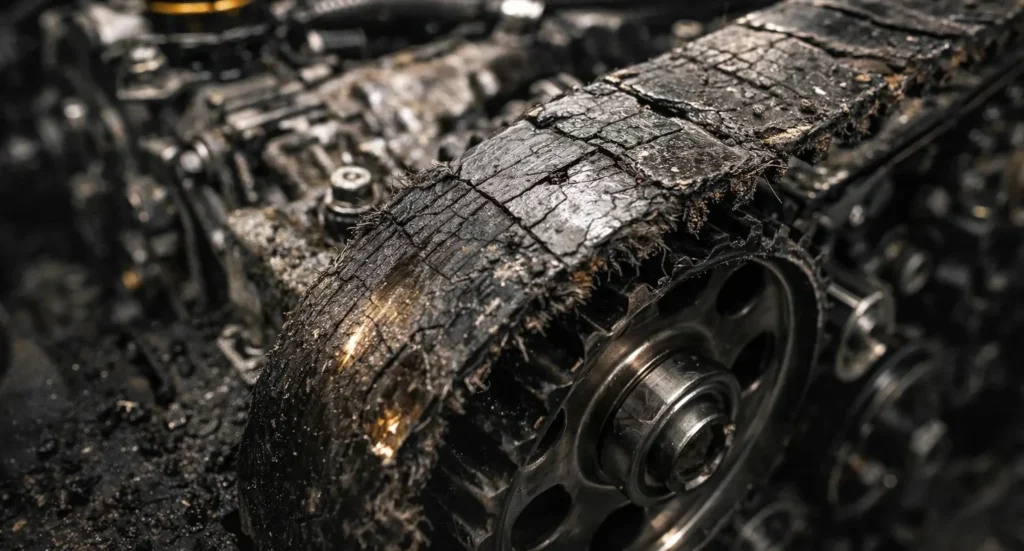
A failing timing belt does not always give advance notice. These signs can help you catch trouble early.
A timing belt problem rarely gives you much time to react. Once it fails, the damage can escalate quickly, especially in engines where internal components depend on precise timing. That is why noticing early timing belt symptoms matters more than many drivers realize.
Some bad timing belt warning signs are obvious, while others are easy to miss or mistaken for unrelated issues. In some cases, symptoms only appear after the belt has already stretched or slipped.
In this guide, we walk through the most common signs of a failing timing belt, what those symptoms may feel or sound like, what they could indicate, and what steps to take next so you can act before a breakdown occurs.
Quick Context: What a Timing Belt Does and Why Failure Is Serious
The timing belt synchronizes the rotation of the crankshaft and camshaft so that engine valves open and close at the correct time. When this timing is even slightly off, engine performance suffers. If the belt breaks completely, serious engine damage can occur depending on the engine design.
It is also important to note that not every vehicle uses a timing belt. Some use a timing chain instead. The first step is confirming what your vehicle has by checking the owner’s manual, service records, or asking a mechanic.
Understanding timing belt problems symptoms starts with knowing how critical this component is to normal engine operation.
Signs of a Failing Timing Belt (The Symptoms Drivers Notice First)
These timing belt symptoms do not confirm the belt is the cause on their own, but they are strong reasons to have the belt system inspected sooner rather than later.
1) Ticking, Clicking, or Rattling Noise From the Engine
One of the most commonly reported signs of a failing timing belt is a ticking or clicking noise coming from the engine area. The sound could be coming from the belt itself or from other parts that are connected to it, like the tensioner or idler pulleys.
Remember that there are many reasons why engines make noise. Don’t ignore or put off service because of strange ticking; instead, use it as a reason to check things out.
2) Engine Misfires, Rough Idle, or Sudden Loss of Performance
Some timing belt symptoms show up as changes in how the engine runs. If the belt stretches or the timing drifts, the timing of the valves may not be right. This can cause the engine to misfire, idle roughly, hesitate when you accelerate, or lose power.
Drivers often say that the engine feels uneven or has trouble when it is loaded. You should never ignore these signs, especially if timing belt service history is unclear.
3) Check Engine Light With Timing-Related Faults
A check engine light doesn’t always mean there’s a problem with the timing belt, but it could be one of the things that are wrong. If the timing goes outside of what is normal, the engine control unit may find a correlation problem and turn on a warning light.
Scanning the fault codes helps you figure out if the problem is with the timing, sensors, or something else. A mechanical inspection is still needed to find out what caused the problem.
4) Oil Leaks Near the Timing Cover Area
Oil leaking near the timing cover is another warning sign worth taking seriously. Oil contamination can weaken the belt material and accelerate wear. Over time, this increases the risk of belt failure.
If oil or coolant leaks are present, they should be repaired promptly and the belt condition checked, even if replacement is not yet scheduled.
5) Hard Starting, No Start, or Sudden Stalling
More advanced timing belt problems symptoms can include hard starting or the engine failing to start at all. In cases where the belt has jumped teeth or snapped, the engine may stall suddenly while driving.
If this happens, avoid repeated attempts to restart the engine. Have the vehicle inspected or towed to prevent further damage.
Why These Bad Timing Belt Warning Signs Happen
Bad timing belt warning signs usually develop due to wear, stretching, damaged belt teeth, tensioner or pulley failure, or fluid contamination. Any of these issues can allow timing to drift gradually or suddenly.
In some cases, the belt itself is still intact, but supporting components fail first. This is why replacing only the belt without addressing tensioners or idlers can still lead to problems.
It is also important to understand that some belts fail with very little warning. This is why following the replacement schedule is just as important as watching for symptoms.
What to Do If You Notice Timing Belt Problems Symptoms
If you notice any of the symptoms discussed above, a calm and structured response is best.
First, check the service history immediately. Confirm when the timing belt was last replaced and at what mileage or age. If the history is unclear, treat the situation as higher risk.
Next, book an inspection as soon as possible. Ask the workshop to assess the belt condition, tensioners, and idlers, and to check for oil or coolant leaks that could affect belt life.
If replacement is due, it is usually smarter to replace the belt as part of a complete kit rather than on its own. This reduces the chance of repeat labor or premature failure.
Until the issue is inspected, avoid aggressive driving or high engine loads.
Listening to Your Engine Before It’s Too Late
If you notice any of these signs of a failing timing belt, it is best to treat them as a prompt for inspection rather than waiting for a breakdown. Timing belt symptoms can be subtle, inconsistent, or appear late, which is why proactive attention matters.
For passenger vehicles, timing belt replacement should always follow manufacturer guidance and be handled by a qualified mechanic using appropriate parts. In industrial environments, timing belts play a similar role in synchronizing motion across machinery and production systems. This is where Jigna Sales becomes relevant for plant managers and maintenance teams. As an experienced industrial belts supplier and manufacturer in India, Jigna Sales supports equipment uptime by providing reliable timing belts and power transmission solutions for industrial applications where precision and durability are critical.
Addressing belt issues early, whether in vehicles or machinery, is one of the simplest ways to prevent costly downtime.
FAQs
Yes — if the timing belt is accessible, a visual inspection by a technician can reveal cracks, fraying, glazing, or missing teeth on the belt surface. These physical signs of deterioration usually mean the belt should be replaced soon. However, many timing belts are hidden behind covers and require professional removal for a proper inspection.
A failing timing belt can trigger the check engine light, especially if its wear causes engine misfires, timing irregularities, or sensor-detected performance issues. While the check engine light can indicate many problems, when combined with other warning signs (noise, performance loss), it’s wise to have the timing belt checked.
Replacing the timing belt before it breaks is critical because a snapped belt can cause catastrophic engine damage — including bent valves, damaged pistons, or complete engine failure — especially in interference engines. Proactive replacement based on mileage and symptom monitoring helps avoid costly repairs and sudden breakdowns.
Driving with a worn or damaged timing belt is risky. As the belt deteriorates, engine timing becomes inaccurate, leading to poor fuel efficiency, misfires, and power loss. If the belt snaps while driving, it can instantly stop the engine and cause severe internal damage, resulting in expensive repairs or complete engine replacement.
Timing belt replacement is relatively affordable compared to the cost of engine repairs caused by belt failure. Replacing a worn belt is a preventive maintenance task, while a broken timing belt can lead to bent valves, damaged pistons, and cylinder head failure—repairs that cost several times more than timely belt replacement.

