
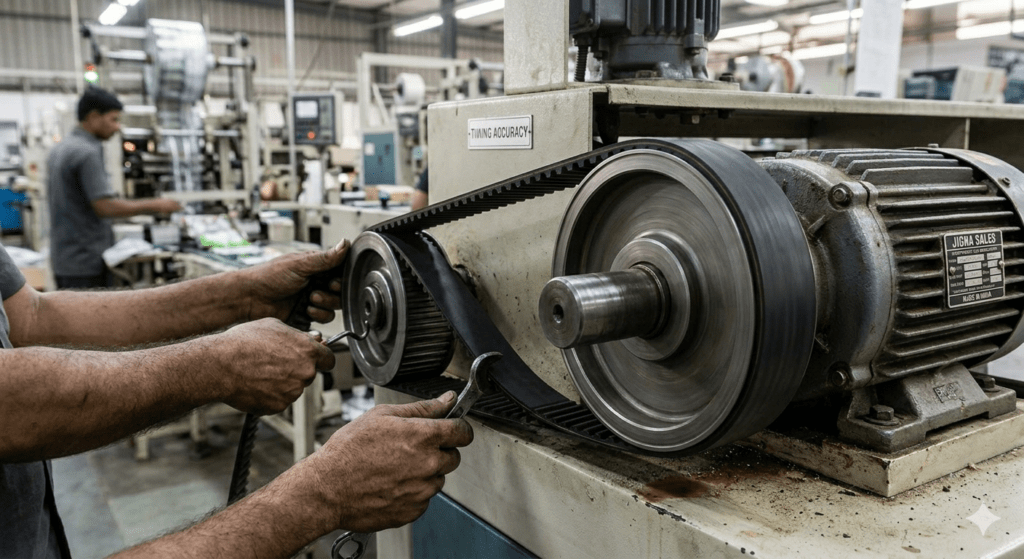
In industrial machinery, small parts often carry a big responsibility. Rubber timing belts are a good example of that. They help machines run in sync, transfer motion accurately, and support steady production across many applications.
But timing belts do not last forever. Over time, wear, load, heat, and operating conditions can affect their performance. When replacement is delayed, the result is not just a worn belt. It can also mean lower efficiency, poor timing accuracy, more maintenance, and avoidable downtime.
This is why it is important to know when industrial timing belts should be replaced, and why the way they are manufactured has a direct effect on machine efficiency.
What Do Industrial Rubber Timing Belts Do?
Industrial timing belts transfer power in a controlled, synchronised way, which makes them important for machines that depend on precise motion.
Unlike ordinary belts, rubber timing belts have teeth on the inner side. These teeth match with pulley grooves and help the belt move without slipping. This is what makes them useful in equipment where timing and positioning matter.
They are widely used in:
- Packaging machines
- Conveyor systems
- Printing presses
- Textile and weaving machinery
- Mining and processing equipment
- Woodworking machinery
Because of this toothed design, industrial timing belts help improve:
- Motion accuracy
- Transmission consistency
- Low-noise operation
- Reduced maintenance needs
In simple terms, they are not just moving parts. They help machines stay aligned, efficient, and dependable during regular operation.
When Should Industrial Rubber Timing Belts Be Replaced?
Industrial rubber timing belts should be replaced when signs of wear begin to affect timing accuracy, belt stability, or machine performance. Waiting for complete failure is not a smart maintenance strategy.
Many businesses replace belts only when something goes wrong. But in industrial settings, a better approach is to replace belts when performance begins to drop.
Here are some common signs that replacement may be needed:
- Cracks on the belt surface
- Worn or damaged teeth
- Frayed belt edges
- Hardening or glazing of the rubber
- Belt noise during operation
- Repeated tension issues
- Loss of synchronisation
- Visible wear after long service hours
If a machine starts showing uneven movement or inconsistent timing, the belt should be checked immediately. In many cases, replacing rubber timing belts at the right time helps prevent bigger mechanical issues later.
Why Do Worn Timing Belts Reduce Machine Efficiency?
Worn timing belts reduce machine efficiency because they affect smooth power transmission, timing accuracy, and the overall stability of the system.
A timing belt may still look usable from the outside, but once its tooth profile, flexibility, or grip begins to weaken, the machine may no longer perform at its best.
This can lead to:
- Inconsistent transmission
- Increased vibration
- More noise during operation
- Uneven machine output
- Higher load on connected components
- More frequent stoppages
When industrial timing belts lose their original form and strength, the machine often has to work harder to deliver the same result. That means efficiency goes down, while maintenance pressure goes up.
How efficiency loss usually shows up in operations
- Production speed becomes less stable
- Output quality may vary
- Machine downtime becomes more frequent
- Maintenance teams need to intervene more often
- Energy use may increase in some systems
So, replacing worn belts on time is not only about avoiding failure. It is also about protecting machine performance.
What Causes Early Timing Belt Replacement?
Early timing belt replacement usually happens because of poor operating conditions, wrong belt selection, or quality issues in the belt itself.
Not every belt wears out early for the same reason. Sometimes the problem is the environment. Sometimes it is installation. And sometimes it begins with the belt design or manufacturing quality.
Some common reasons include:
- Incorrect belt size or pitch
- Misalignment of pulleys
- Over-tensioning or under-tensioning
- Exposure to heat, oil, dust, or abrasion
- Heavy load conditions
- Poor material quality
- Wrong belt profile for the application
This is why choosing the right rubber timing belts matters just as much as maintaining them. A belt that does not match the machine or operating conditions will naturally wear faster, no matter how often it is checked.
How Does Proper Manufacturing Improve Timing Belt Efficiency?
Proper manufacturing improves timing belt efficiency by ensuring that the belt has accurate dimensions, consistent tooth profiles, reliable material strength, and better resistance to wear.
This part matters more than many buyers realise.
A well-manufactured belt performs better because it is made to engage smoothly with the pulley, hold its shape under load, and maintain stable motion over time. That directly supports machine efficiency.
Good manufacturing improves:
- Tooth accuracy
- Dimensional consistency
- Tensile strength
- Wear resistance
- Operational stability
- Service life
When the manufacturing quality is strong, the belt can deliver:
- Better synchronisation
- Lower slippage risk
- Smoother running
- More dependable output
- Fewer maintenance interruptions
This is one reason many buyers look for trusted rubber timing belt manufacturers in India who understand industrial performance requirements, not just product supply.
Why Does Belt Profile and Application Fit Matter So Much?
Belt profile and application fit matter because even a good timing belt can underperform if it is not matched correctly to the machine’s design, speed, load, and operating condition.
Not all timing belts are the same. Different machines need different belt profiles, pitches, and performance characteristics.
For example, timing belts may vary by:
- Tooth profile
- Pitch size
- Thickness
- Width
- Load-handling capacity
This matters because the wrong fit can cause:
- Poor engagement with pulleys
- Faster wear
- Reduced transmission accuracy
- Shorter belt life
- Lower overall efficiency
Key factors that affect performance
| Factor | Why It Matters |
| Belt Profile | Helps the belt engage correctly with pulleys |
| Pitch Accuracy | Supports smooth and consistent synchronisation |
| Material Quality | Improves wear resistance and service life |
| Application Fit | Ensures the belt suits load and operating conditions |
This is why sourcing from knowledgeable timing belt manufacturers in India can make a real difference. The goal is not only to buy a belt. The goal is to buy the right belt for the job.
What Signs Show You Need to Review Belt Selection, Not Just Replace the Belt?
If the same timing belt problem keeps returning, the issue may be with belt selection, application fit, or sourcing quality, not only normal wear.
A single replacement may solve a short-term issue. But repeated belt problems often point to something deeper.
Watch for signs like:
- Frequent replacements in a short time
- Repeated tension loss
- Similar wear patterns on every replaced belt
- Performance drop even after a new belt is installed
- Belt life not matching expected operating conditions
In such cases, it is worth reviewing:
- Whether the belt profile is correct
- Whether the pitch and size are suitable
- Whether the material quality is strong enough
- Whether the supplier understands the application properly
This is where working with experienced rubber timing belt manufacturers becomes important. Reliable sourcing helps improve consistency, reduce replacement frequency, and support better machine performance over time.
Timely Replacement and Quality Manufacturing Keep Systems Efficient
Replacing industrial timing belts at the right time is an important part of efficient machine operation. It helps maintain synchronisation, protect output quality, and reduce avoidable downtime. Just as importantly, the manufacturing quality of the belt affects how well it performs under real working conditions.
A timing belt should not be seen as a basic replacement item. It is a performance component. When the belt is correctly selected, properly manufactured, and replaced at the right stage, it supports smoother operation and better long-term efficiency.
At Jigna Sales, we have been serving industrial belt requirements for 54 years, and that experience shapes the way we understand performance, durability, and application fit. We manufacture and supply industrial timing belts designed for dependable power transmission across varied industrial uses. Our range includes quality rubber timing belts developed for consistent performance, low maintenance, and reliable operation in demanding environments.
As one of the experienced rubber timing belt manufacturers in India, we understand that belt efficiency depends on more than availability. It depends on correct profile selection, material quality, and manufacturing precision. If you are looking for durable industrial timing belts backed by practical expertise, we are here to help you find the right solution for your requirements.

