High-quality industrial V-belts can help reduce machine downtime and maintenance costs by providing reliable power transmission, reducing premature wear and supporting consistent machinery performance. When correctly selected, installed and maintained, these belts can minimise unexpected breakdowns, frequent replacements and production interruptions.
Industries such as automotive, textile, packaging, engineering and manufacturing depend on industrial belts to operate machinery efficiently. However, unsuitable belt selection, inconsistent product quality and improper maintenance can increase operational expenses.
Established in 1972, Jigna Sales Corporation is a Mumbai-based manufacturer, supplier, distributor and exporter of industrial belts, offering various power transmission products, including industrial V-belts under its Optiset product portfolio.
Understanding how V-belt quality influences machinery performance can help businesses improve equipment reliability and make more informed procurement decisions.
What Are Industrial V-Belts and How Do They Work?
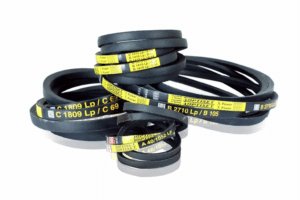
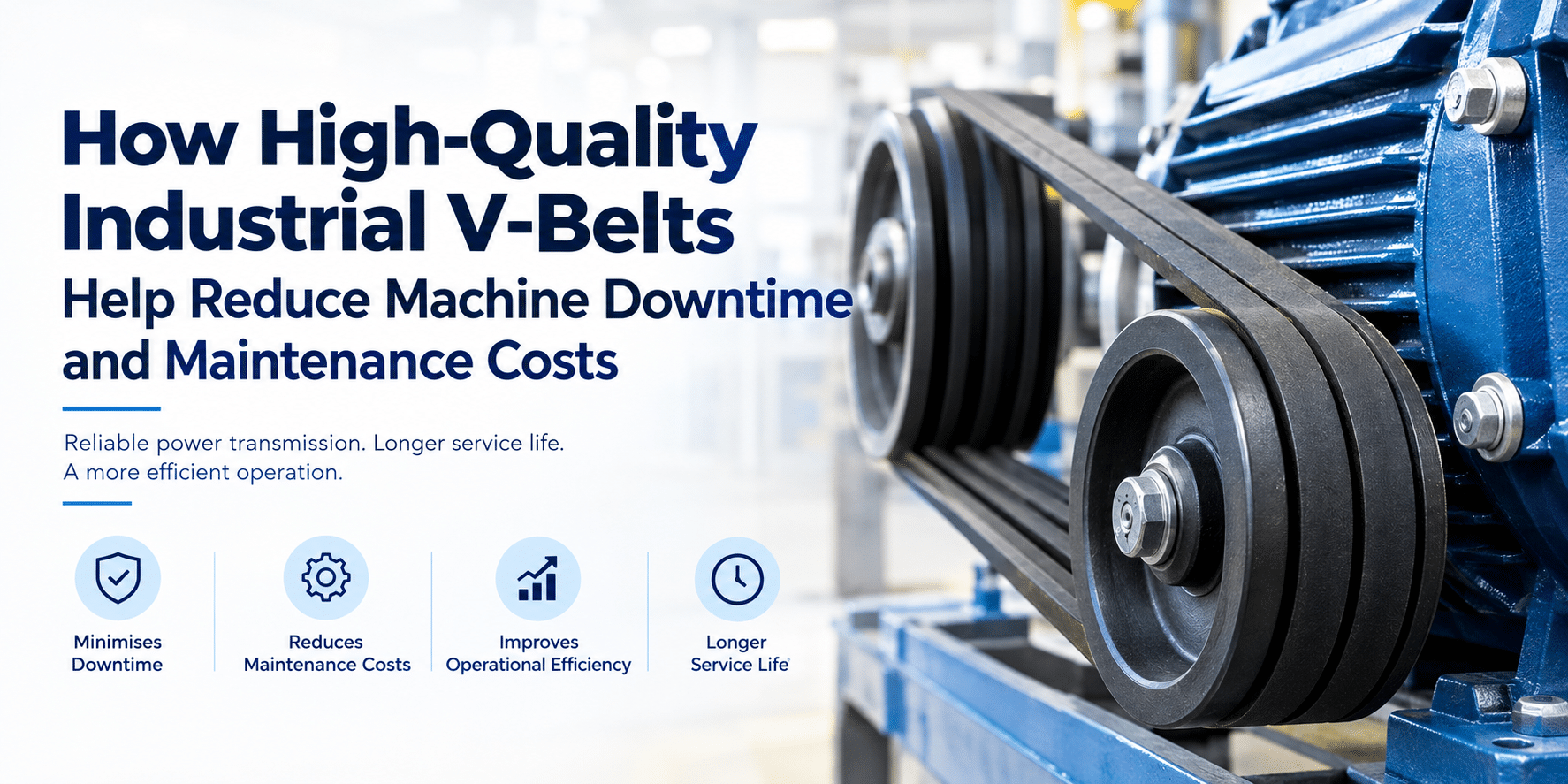
An industrial V-belt is a flexible power transmission component with a trapezoidal cross-section that transfers mechanical power between pulleys. Its shape creates a wedging action within the pulley groove, providing the friction required to transmit power.
Industrial vee belts are commonly used in machinery such as:
- Industrial motors and pumps.
- Air compressors and ventilation systems.
- Textile processing machinery.
- Agricultural equipment.
- Manufacturing and production machinery.
- Packaging and material handling systems.
The efficiency of a V-belt drive depends on belt construction, pulley compatibility, operating load, speed, alignment and installation tension.
Selecting a suitable product from experienced V-belt manufacturers helps businesses match these requirements to their machinery.
How Do High-Quality Industrial V-Belts Reduce Machine Downtime?
High-quality industrial V-belts can reduce machine downtime by maintaining dependable power transmission, resisting premature wear and supporting reliable performance under specified operating conditions.
1. Reduce Premature Belt Failure
V-belts manufactured with suitable rubber compounds and tensile reinforcement can withstand the repeated flexing and mechanical stresses associated with industrial operations.
Selecting belts according to their rated operating conditions can reduce the likelihood of premature cracking, stretching and breakage.
2. Minimise Belt Slippage
A correctly sized and tensioned industrial V-belt maintains appropriate contact with the pulley grooves. This helps minimise slippage, excessive friction and heat generation.
Reduced slippage also supports more consistent machinery operation.
3. Reduce Unexpected Production Interruptions
Unexpected belt failure can stop production equipment and disrupt manufacturing schedules.
Using suitable industrial belts, maintaining replacement stock and conducting periodic inspections can reduce the risk of unplanned equipment stoppages.
4. Support Consistent Power Transmission
V-belts designed for the required load and speed can help machinery maintain stable operating performance without excessive vibration or frequent transmission problems.
5. Reduce Replacement Frequency
A properly selected and maintained V-belt may provide a longer service life than an unsuitable alternative. This can reduce replacement frequency, maintenance labour and associated production losses.
What Causes Premature Industrial V-Belt Failure?
Premature V-belt failure is commonly associated with incorrect installation tension, pulley misalignment, worn pulley grooves, excessive loads, unsuitable belt selection and environmental exposure.
Even high-quality industrial V-belts can fail prematurely if the drive system is incorrectly designed or maintained.
Common V-Belt Problem | Possible Cause | Recommended Solution |
Belt slippage | Insufficient tension or worn pulley grooves | Check tension and inspect pulleys |
Premature cracking | Excessive heat or unsuitable pulley diameter | Review operating conditions and belt specifications |
Uneven belt wear | Pulley misalignment | Correct pulley alignment |
Frequent belt breakage | Excessive load or unsuitable belt capacity | Review drive requirements and belt rating |
Excessive belt stretching | Overloading or deterioration of tensile reinforcement | Inspect drive loads and replace damaged belts |
Belt squealing | Slippage, contamination or incorrect tension | Identify the underlying cause and correct it |
Belt turnover | Misalignment, unsuitable grooves or unstable loading | Inspect the drive system and belt profile |
Excessive vibration | Incorrect tension or drive system problems | Inspect alignment, pulleys and drive components |
Maintenance teams should identify the underlying cause of belt failure before installing replacement belts. Repeated replacement without correcting the original problem can increase maintenance costs.
Which Types of Industrial V-Belts Help Improve Machinery Reliability?
Different types of industrial V-belts are designed for specific power transmission requirements. Selecting the correct belt type according to machinery design, load, speed and operating conditions can help improve equipment reliability.
Type of Industrial V-Belt | Common Applications | Key Advantages |
Classical V-belts | Pumps, motors, fans and general machinery | Versatile power transmission |
Wedge V-belts | Compact industrial drive systems | Higher power transmission capacity relative to belt size in suitable drives |
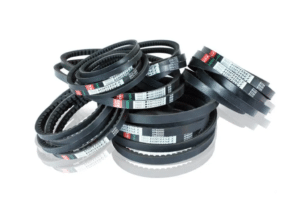
Cogged V-belts | Machinery requiring greater belt flexibility | Improved flexibility around pulleys |
Rubber banded V-belts | Heavy-duty machinery and fluctuating loads | Improved stability in suitable multi-belt drives |
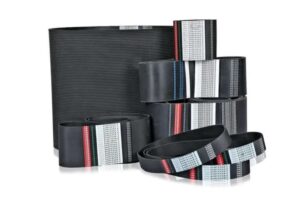
Poly V-belts | Compact and high-speed machinery | Flexible, multi-ribbed power transmission |
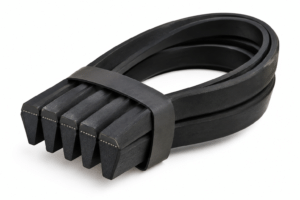
For example, rubber banded V-belts feature multiple belt sections connected by a common backing. This construction helps maintain belt stability in suitable applications involving variable loads and vibration.
Jigna Sales Corporation offers rubber banded belts in classical, wedge and narrow belt configurations to support different industrial drive requirements.
Businesses comparing V-belt manufacturers in India should evaluate product suitability rather than assuming that one belt type is suitable for every application.
What Makes an Industrial V-Belt Durable and Cost-Effective?
A durable and cost-effective industrial V-belt combines suitable material construction, tensile strength, dimensional stability, flexibility and resistance to the operating environment.
When evaluating products from V-belt suppliers, industrial buyers should consider the following quality characteristics:
- Rubber compounds: Suitable rubber compounds help belts withstand repeated flexing and application-specific operating conditions.
- Tensile reinforcement: Reinforcement supports load transmission and dimensional stability.
- Length stability: Helps maintain appropriate belt tension and consistent drive performance.
- Dimensional accuracy: Ensures compatibility with pulley grooves.
- Flexibility: Allows belts to operate around pulleys within their specified diameter limits.
- Environmental resistance: Helps belts withstand heat, oil or other exposures when specifically rated for those conditions.
Established industrial belt manufacturers should provide technical information about their products so buyers can evaluate belt suitability before purchasing.
What Are the Technical Features of Optiset V-Belts?
Optiset is an industrial belt brand offered by Jigna Sales Corporation. Its product portfolio includes V-belts, cogged belts, rubber banded belts and Poly V-belts.
According to Jigna Sales’ published V-belt specifications, its product features include:
- High-performance polymer construction.
- High-tenacity polyester reinforcement in specified products.
- Heat-stretching and length-stabilisation processes.
- Shock absorption characteristics.
- Multiple belt sections for different industrial requirements.
These characteristics are intended to support dimensional stability, dependable power transmission and consistent operation when the belt is correctly specified.
Businesses considering an Optiset V-belt should confirm the specific product construction, load capacity and environmental resistance required for their machinery.
Source: Jigna Sales – V-Belt Product Specifications.
What Technical Specifications Should Buyers Check to Prevent V-Belt Failure?
Industrial buyers should check the V-belt section, top width, height, length, pulley diameter, power transmission capacity and operating speed before purchasing replacement belts.
Incorrect belt dimensions can result in poor pulley engagement, slippage and premature wear.
The following table provides actual examples from Jigna Sales Corporation’s published classical V-belt catalogue.
V-Belt Section | Top Width | Belt Height | Listed Minimum Pulley Diameter |
A | 13 mm | 8 mm | 71 mm |
B | 17 mm | 11 mm | 112 mm |
C | 22 mm | 14 mm | 180 mm |
D | 32 mm | 19 mm | 355 mm |
E | 38 mm | 23 mm | 500 mm |
Source: Jigna Sales Corporation – Industrial V-Belt Specifications.
For example, a classical B-section V-belt has a listed top width of 17 mm and a height of 11 mm. Replacing it with a belt of an incompatible section can affect pulley engagement and power transmission.
However, dimensional compatibility alone does not guarantee suitability. Buyers should also confirm drive loads, belt length, operating speed and manufacturer-specific installation requirements.
Working with an experienced industrial V-belts manufacturer can help businesses identify appropriate replacement products and reduce procurement errors.
How Do High-Quality V-Belts Reduce Industrial Maintenance Costs?
High-quality V-belts can help reduce maintenance costs by lowering replacement frequency, minimising unexpected equipment stoppages and reducing the labour required for recurring belt replacements.
Businesses should evaluate the total cost of ownership rather than considering only the initial belt purchase price.
Maintenance Cost Factor | Potential Benefit of Suitable High-Quality V-Belts |
Belt replacement expenses | Fewer replacements when longer service life is achieved |
Maintenance labour | Reduced frequency of replacement activities |
Production downtime | Lower risk of unexpected belt-related stoppages |
Energy expenses | Reduced power losses associated with excessive slippage |
Equipment maintenance | Reduced risk of problems associated with unsuitable belt tension |
Emergency procurement | Reduced need for urgent replacement purchases |
A lower-priced V-belt may initially appear cost-effective. However, if it requires frequent replacement or causes production interruptions, its overall operating cost may be higher.
How Can Businesses Calculate the Total Cost of V-Belt Ownership?
Businesses can estimate annual V-belt ownership costs by calculating purchase expenses, replacement labour and production downtime.
Annual V-belt ownership cost = Belt purchase costs + Replacement labour costs + Production downtime costs
Consider the following hypothetical example of two industrial V-belts operating under comparable conditions.
Cost Factor | Standard V-Belt | Higher-Quality V-Belt |
Purchase price per belt | ₹800 | ₹1,200 |
Replacement events per year | 4 | 2 |
Annual belt purchase cost | ₹3,200 | ₹2,400 |
Labour cost per replacement | ₹500 | ₹500 |
Annual replacement labour cost | ₹2,000 | ₹1,000 |
Downtime per replacement | 1 hour | 1 hour |
Production loss per hour | ₹5,000 | ₹5,000 |
Annual downtime cost | ₹20,000 | ₹10,000 |
Total annual cost | ₹25,200 | ₹13,400 |
In this illustrative scenario, the higher-priced belt reduces annual operating expenses by ₹11,800, despite its higher initial purchase price.
Actual savings depend on belt service life, machinery requirements, maintenance practices and production costs. This example is not a measured performance claim for Optiset or any other V-belt brand.
Industrial buyers comparing V-belt manufacturers in India should use their actual maintenance and replacement records to evaluate long-term cost-effectiveness.
What Are the Warning Signs That an Industrial V-Belt Needs Replacement?
Industrial V-belts should be inspected when they show visible cracks, excessive wear, glazing, fraying, recurring slippage or frequent loss of tension.
Identifying early warning signs allows maintenance teams to plan replacements before unexpected machinery failure occurs.
Warning Sign | What It May Indicate |
Visible cracks | Material deterioration or unsuitable operating conditions |
Shiny or glazed surface | Excessive slippage or friction |
Frayed belt edges | Pulley misalignment or mechanical interference |
Frequent tension loss | Belt deterioration or installation problems |
Unusual operating noise | Slippage, alignment or drive system issues |
Damaged belt sidewalls | Worn pulley grooves or incompatible belt profiles |
Uneven wear | Incorrect pulley alignment or load distribution |
Businesses should avoid continuing to operate visibly damaged belts, as unexpected failure can interrupt production and potentially affect connected drive components.
Maintenance teams should consult qualified technicians and follow equipment-specific procedures when inspecting or replacing industrial belts.
What Maintenance Practices Help Extend Industrial V-Belt Life?
Regular inspection, correct belt tension, proper pulley alignment and suitable operating conditions can help extend industrial V-belt service life.
Businesses can follow these preventive maintenance practices:
1. Inspect Belt Condition Regularly
Check industrial V-belts for cracks, glazing, fraying and unusual wear. Establish inspection intervals based on operating hours, equipment criticality and manufacturer recommendations.
2. Maintain Correct Belt Tension
Insufficient tension can cause slippage, while excessive tension can increase the load on bearings and shafts. Follow the manufacturer’s recommended tensioning procedure.
3. Check Pulley Alignment
Misaligned pulleys can contribute to uneven wear and premature failure. Use appropriate alignment tools and equipment-specific tolerances.
4. Inspect Pulley Groove Condition
Worn or damaged pulley grooves can reduce belt contact and affect power transmission. Inspect pulleys whenever damaged belts are replaced.
5. Protect Belts From Unsuitable Operating Conditions
Excessive heat, oil, chemicals and environmental contamination can affect belt performance. Select industrial belts rated for the relevant operating environment.
6. Maintain Critical Replacement Stock
Keep suitable replacement belts available for critical machinery to reduce delays associated with emergency procurement.
All inspections and replacement activities should be performed after appropriate machinery shutdown, energy isolation and lockout procedures.
What Should Buyers Check When Purchasing Replacement Industrial V-Belts?
Before purchasing replacement industrial V-belts, buyers should verify the existing belt identification number, belt section, length, pulley dimensions, machinery load and operating conditions.
The following information should be shared with V-belt suppliers when requesting replacement products.
Information Required | Purpose |
Existing belt identification number | Helps identify the replacement configuration |
V-belt section | Ensures compatibility with pulley grooves |
Belt length and width | Confirms dimensional suitability |
Machinery type | Helps determine application requirements |
Operating speed and load | Assists with power transmission evaluation |
Operating temperature | Helps identify suitable belt construction |
Required quantity | Supports replacement and bulk procurement planning |
Existing belt failure symptoms | Helps identify potential drive system problems |
Businesses sourcing products from V-belt manufacturers in Mumbai or other industrial locations should request relevant product specifications before confirming an order.
If the existing belt identification is unreadable, buyers can provide photographs, measurements and machinery specifications to assist with product identification.
How Can Businesses Identify Reliable V-Belt Manufacturers in India?
Reliable V-belt manufacturers should offer detailed product specifications, consistent manufacturing quality, suitable product options, technical assistance and dependable supply capabilities.
Industrial buyers should consider the following factors when comparing manufacturers:
- Manufacturing experience and industry knowledge.
- Product range and availability of different belt sections.
- Material quality and manufacturing processes.
- Product testing and quality control capabilities.
- Availability of technical catalogues.
- Bulk procurement and repeat order capabilities.
- Technical assistance for belt selection.
- Manufacturing and distribution capabilities.
Businesses working with V-belt exporters should additionally confirm export documentation, packaging requirements, shipping arrangements and delivery schedules.
Choosing an experienced manufacturer or supplier can help businesses maintain consistent product specifications across recurring orders and reduce procurement-related disruptions.
Why Choose Jigna Sales Corporation for Industrial V-Belts?
Jigna Sales Corporation is an industrial belt manufacturer, supplier and exporter based in Mumbai, India. Established in 1972, the company offers industrial V-belts and other power transmission products for different machinery applications.
Businesses evaluating V-belt manufacturers in India can consider Jigna Sales Corporation for the following reasons:
- Over five decades of industry experience: Operating in the industrial belt industry since 1972.
- Dedicated testing facility: The company’s published information identifies a 500 sq. ft. facility for product testing.
- Manufacturing quality control: Product inspections across different stages of manufacturing.
- Extensive V-belt portfolio: Classical V-belts, wedge belts, cogged belts, rubber banded belts and Poly V-belts.
- Detailed product specifications: Published catalogues containing belt sections, dimensions and pulley diameter information.
- Optiset product portfolio: Industrial rubber belts designed for various power transmission requirements.
- Technical selection assistance: Support for identifying suitable products based on machinery specifications.
Source: About Jigna Sales Corporation.
Whether businesses are searching for a V-belt dealer in Mumbai, experienced V-belt exporters or a reliable industrial V-belts manufacturer, Jigna Sales Corporation offers multiple industrial belt categories through a single procurement partner.
Where Can Businesses Buy Industrial V-Belts in Mumbai?
Businesses looking for V-belt suppliers in Mumbai can contact Jigna Sales Corporation for industrial power transmission belt requirements.
Business Information | Details |
Company Name | Jigna Sales Corporation |
Established | 1972 |
Location | 39, Nagdevi Cross Lane, Ground Floor, Mumbai, Maharashtra – 400003 |
Business Type | Manufacturer, Supplier, Distributor and Exporter |
Product Categories | V-belts, cogged belts, rubber banded belts, Poly V-belts and timing belts |
Brand | Optiset |
Contact Number | +91 9029056060 |
Website |
Businesses can share their machinery specifications, belt dimensions and required quantities with the company to discuss product suitability, availability and quotations.
Improve Machinery Reliability With the Right Industrial V-Belts
Reducing machine downtime and maintenance costs requires more than purchasing replacement belts. Businesses should prioritise product quality, technical compatibility, preventive maintenance and dependable supply when selecting industrial V-belts.
With over five decades of industry experience, a dedicated testing facility and an extensive industrial belt portfolio, Jigna Sales Corporation supports businesses with various power transmission requirements.
Whether you are comparing industrial belt manufacturers in India, looking for reliable V-belt suppliers or sourcing Optiset V-belts for industrial machinery, selecting suitable products can help improve long-term operational efficiency.
Contact Jigna Sales Corporation today to discuss your industrial V-belt requirements and request a quotation.
FAQ's
Suitable high-quality V-belts can reduce premature wear, excessive slippage and unexpected belt failure when correctly selected, installed and maintained.
Durable and cost-effective V-belts feature suitable materials, tensile reinforcement, dimensional stability and appropriate load ratings. The best option depends on machinery requirements and operating conditions.
There is no universal replacement interval. Belt replacement depends on operating hours, load, environmental conditions, maintenance practices and physical belt condition.
Incorrect belt tension, pulley misalignment, unsuitable belt selection, excessive loads and worn pulleys are common causes of premature V-belt failure.
Correctly selected and tensioned V-belts can help reduce power losses associated with excessive slippage. Actual energy savings depend on the drive system and operating conditions.
No. V-belt quality should be evaluated based on material construction, technical specifications, application suitability and expected service life rather than price alone.
Jigna Sales Corporation is an established V-belt manufacturer, supplier and exporter based in Mumbai, operating since 1972 and offering multiple industrial belt configurations.