
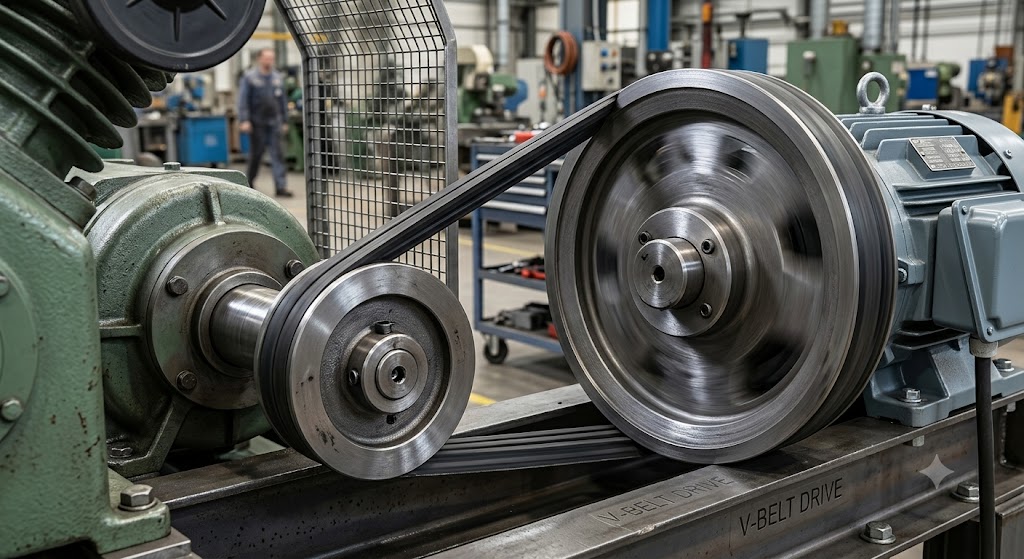
In any power transmission system, small setup details can make a big difference in performance. One of the most important factors is proper pulley alignment in a V belt drive. When pulleys are not aligned correctly, even a good-quality belt can wear out faster and reduce machine efficiency.
A V belt drive is widely used in industrial machines, compressors, HVAC systems, and manufacturing equipment because of its simple design and reliable power transfer. However, its performance depends heavily on how well the pulleys are positioned and maintained.
Even a slight misalignment can lead to issues such as vibration, belt slippage, noise, and energy loss. This is why understanding pulley alignment is essential for smooth and long-lasting machine operation.
What Is a V Belt Drive System?
A V belt drive is a simple power transmission system that uses a belt and two pulleys to transfer motion from one shaft to another. It works on friction, with the belt sitting in the pulley grooves and helping ensure the smooth transfer of power.
This system is widely used because it is cost-effective, easy to install, and works well in many industrial machines. From small equipment to heavy-duty systems, a V belt drive supports stable and continuous operation when installed correctly.
The performance of this system depends on proper pulley positioning, belt tension, and regular maintenance, which directly affect its efficiency and lifespan.
What Is Pulley Alignment and Why It Matters
Alignment of the pulleys involves arranging the pulleys in such a way that they move along a straight path. If the pulleys are well-aligned, then the flat belt drive moves without exerting extra tension on the belt.
Misalignment of the pulleys results in the belt not sitting properly in the grooves. Consequently, there is uneven wear of the belt, slippage of the belt, and power losses in the process of transmission.
Proper alignment helps ensure:
- Smooth belt movement
- Reduced vibration and noise
- Better energy efficiency
- Longer belt and pulley life
In short, correct alignment keeps the entire system stable and prevents avoidable breakdowns.
Step-by-Step Guide to Aligning Pulleys
Proper pulley alignment is a simple process, but it needs attention to detail. A correctly aligned system helps the V belt drive run smoothly, reduces wear, and improves overall machine efficiency.
Step 1: Inspect the Current Setup
Start by checking the condition of the belt and pulleys. Look for signs of uneven wear, cracks, or damage. If any part is heavily worn, it should be replaced before alignment.
Step 2: Check Parallel Positioning
Make sure to put a ruler or other device along both pulleys. They should be aligned in a straight line without any inclination or tilting whatsoever.
Step 3: Verify Groove Matching
Ensure the belt sits properly inside the pulley grooves. The belt should not lean to one side or ride unevenly. Proper seating ensures a better grip and smoother movement.
Step 4: Adjust Motor or Shaft Position
If there is misalignment, it can be fixed by slightly adjusting the position of the motor or the shaft base.
Step 5: Run a Trial Check
After the completion of alignment, run the machinery for a couple of minutes and check the behaviour of the belt, sound, and vibration.
Step 6: Final Tightening and Locking
All mounting bolts should be tightened after ensuring proper alignment to keep everything secure while running.
Proper alignment of pulleys does not only increase the efficiency of the flat belt drive system but also decrease the need for maintenance and extends the life of the belt and machine parts.
Common Mistakes in Pulley Alignment
Even a simple V belt drive system can face performance issues if pulley alignment is not done correctly. Many problems come from small installation or maintenance errors that are often ignored.
1) Ignoring Minor Misalignment – Sometimes, minor misalignments may not appear right away, but eventually, they become a problem that causes wearing down of the belts, which means lower efficiency.
2) Incorrect Belt Tension – If the belt is too tight or too loose, it puts extra stress on the pulleys and bearings. This leads to faster wear and unstable performance.
3) Using Worn-Out Pulleys – Old or damaged pulleys do not allow proper belt seating. This causes slipping, vibration, and uneven load distribution in the V belt drive.
4) Skipping Alignment Checks After Installation – Many systems are not rechecked after initial setup. Without a final inspection, small errors remain and later turn into bigger issues.
5) Poor Base or Motor Mounting – If the motor base is not stable, the alignment shifts during operation. This affects belt tracking and overall machine performance.
V Belt A Section and Its Industrial Usage
The V belt A section is one of the most commonly used belt profiles in light to medium-duty industrial applications. It is designed to handle moderate loads while ensuring smooth and efficient power transmission.
1) Where It Is Commonly Used
The V belt A section is widely used in small machines, workshop equipment, agricultural machinery, and light industrial systems where load requirements are not very high.
2) Why Alignment Is Important for A Section Belts
Proper alignment is essential because the A section belts operate in compact machines, where even minor alignment errors can affect their performance.
3) Performance Impact
With correct alignment of the V belt A section, there is smooth operation, reduced vibration, and greater durability. In the event of improper alignment, slipping occurs, necessitating replacement.
How Proper Alignment Improves Efficiency
Correct pulley alignment plays a direct role in improving the overall performance of a V belt drive system. When everything is properly aligned, the system runs more smoothly, with less resistance and better power transfer.
1) Better Energy Use – If the parts are correctly aligned, then the friction will be minimised, and the belt will travel along a straight line. In doing so, the machine can use energy effectively without wasting any.
2) Longer Belt Life – With the pulleys aligned, the belt’s wear and tear will be uniform rather than one-sided.
3) Reduced Maintenance Needs – A well-aligned system requires fewer adjustments and breakdown repairs. This helps reduce downtime and keeps operations stable.
4) Stable Machine Performance – Machines run more consistently when alignment is correct. It reduces vibration, noise, and sudden load changes during operation.
Role of V Belt Manufacturers and Quality Selection
The performance of a V belt drive does not depend only on alignment, but also on the quality of the belt itself. This is where reliable V belt manufacturers play an important role in ensuring consistent performance and durability.
1) Importance of Quality Manufacturing – Good quality belts are designed to maintain shape, grip, and strength even under continuous load. This helps maintain proper alignment and smooth operation.
2) Why Supplier Choice Matters – Choosing trusted V belt manufacturers in India ensures that the belts meet industrial standards and perform reliably in different working conditions.
3) V Belt Export Quality Standards – Many V belt exporters follow strict quality checks to ensure belts perform well in both domestic and international markets. This makes them suitable for a wide range of industrial applications.
Even the best alignment setup will not perform well if the belt quality is poor. That is why both alignment and manufacturer selection must be considered together for long-term efficiency.
Keeping V Belt Drive Systems Efficient for the Long Run
Maintenance and proper alignment of a V belt drive system is very important for the efficient functioning of any industrial equipment. The alignment of the pulley and the type of belt used, for example, V belt A section is of great importance to performance and energy efficiency.
These simple actions will ensure there is no breakdown and that maintenance costs are minimised. When combined with proper alignment techniques, these simple activities lead to greater efficiency and improved equipment performance.
When it comes to reliable power transmission solutions, Jigna Sales supports industries with a wide range of products, including V belt manufacturers in India, standard belts and solutions for various applications. Their offerings are also supplied through V belt exporters, serving both domestic and international industrial needs with a focus on quality and consistency.